




Your roadmap says six months. Your team says nine. Hiring takes four — if you find the people — and by the time they're productive, the market window will have closed. This is the scene that pushes almost every company to look outside for the first time: you need more development capacity than you have, and you need it this quarter, not next year.
Scaling with external development works — we've seen it work many times and fail just as many. The difference is almost never the vendor: it's choosing well when to do it, what to outsource and how to integrate it. This guide is about that.
When It Makes Sense (The Clear Signals)
- A demand spike with an expiry date. A migration, a launch, a certification a customer demands. If the need disappears in six months, hiring staff for it means buying the problem at twice the price: the real cost of a permanent hire includes recruiting, onboarding and — the one nobody counts — what to do with that person when the spike passes.
- You're missing a one-off specialty. You need someone who has set up CI/CD pipelines twenty times, or who knows AI regulation, or who has migrated to Kubernetes without dying. For specialties you'll use once, buying the experience is cheaper than building it.
- The internal team is at its limit and hiring won't arrive in time. The senior market is what it is: three to four months per hire if you're lucky. A well-integrated external team starts in weeks.
- You want to try before committing. A three-month external collaboration tells you more about whether you need that profile on staff than any recruitment process.
When It Does NOT Make Sense
Just as important. External development fails predictably when:
- You outsource the core without an internal team. If the product IS your business and nobody inside understands the code, you're the vendor's hostage. The healthy rule: critical domain and architecture knowledge lives inside; extra capacity can come from outside.
- You're looking for "cheap hands" for code nobody reviews. External code without internal review is technical debt with a delivery date. If nobody inside can review what comes in, today's savings are tomorrow's audit — or rewrite.
- The problem is management, not capacity. If the current team is slow because of chaotic requirements, decisions that never arrive or priorities that change weekly, more people (internal or external) only amplify the chaos. Fix the management first.
- It's forever. If the need is permanent, the accumulated external cost overtakes the internal one. Outsourcing the permanent is renting when you should buy.
The Three Models (and Where Each Fits)
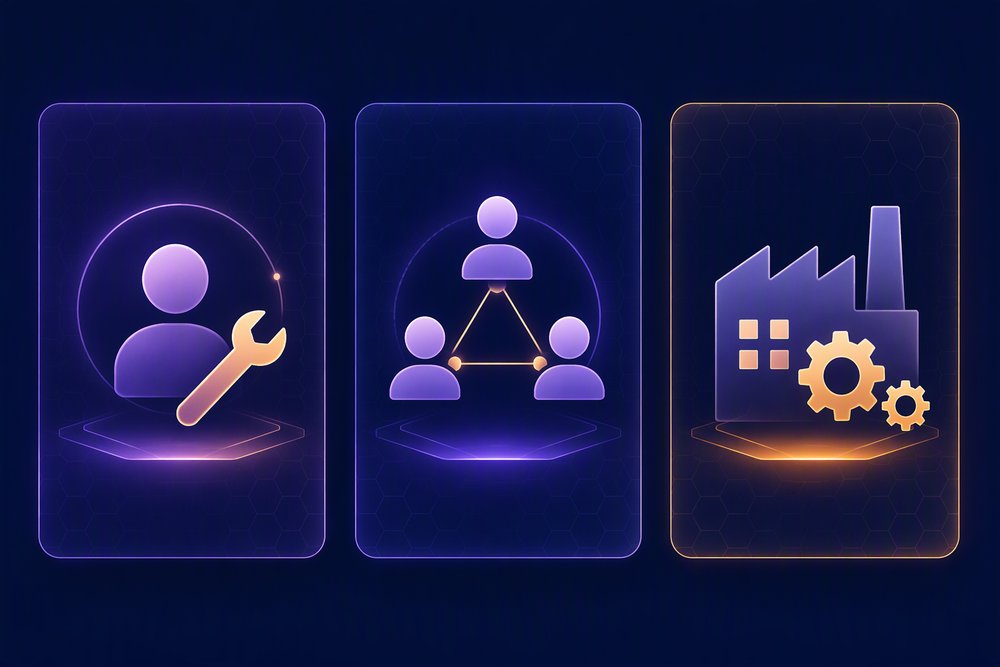
- Targeted reinforcement (one specialist or two): they join your team, your tools and your ceremonies. Ideal for spikes and specialties. Requires your team to be able to absorb them: minimal documentation, fast access, someone answering their questions on day one.
- Dedicated team: a complete unit (devs + lead) that takes a scoped feature or module, with its own cadence but inside your architecture and your standards. Ideal when the work is delimitable: "the new admin panel", "the monolith migration".
- Fixed-scope project: you hand over the problem and receive the product. It only works with genuinely stable requirements — which is much rarer than it looks at signing time. If the scope will move, the fixed price becomes a change-request war.
How to Integrate It So It Works
Most failures aren't technical: they're integration failures. What separates the collaborations that work:
- Same channel, same ceremonies. The external person in your Slack, your standup, your board. If they work in a parallel channel with weekly deliveries, you have a vendor, not reinforcement — and the integration friction at the end will eat the savings.
- Shared definition of done. Tests, code review, standards — the same for inside and outside. External code that enters without passing your CI and your reviews isn't your code yet.
- Access and context from day one. Every week of "we don't have the accounts ready" is paid at external rates. Prepare the onboarding as if it were a permanent hire: because it is one, temporarily.
- Knowledge transfer by contract. Decision documentation, handover sessions, no knowledge living only in the external person's head. When the collaboration ends — and it will — the knowledge stays home.
The Real Math
The honest comparison isn't "external rate vs. salary": it's external rate vs. total staff cost (salary + 30% overheads + recruiting + months of ramp-up) and, above all, vs. the cost of not having the capacity: the launch that arrives late, the customer that won't wait. When the spike is real and temporary, external wins almost every time. When the need is structural, internal wins almost every time. The mistake is using one's tool for the other's problem.
In Summary
External development works for spikes with expiry dates, one-off specialties and urgent capacity while you hire; it fails when you outsource the core without an internal team, when nobody reviews what comes in, or when the real problem was management. Choose the model according to the work (reinforcement, dedicated team or project), integrate it for real — same channel, same standards, same CI — and lock knowledge transfer into the contract. Used well, it's the fastest lever a company has; used badly, it's debt with an invoice.
If you're considering reinforcing your team — or you need a dedicated team for a specific module — we'll tell you frankly whether it fits your case and how we'd integrate it. Let's talk about your situation →
Keep reading: How much does custom software cost: an honest budgeting guide.