




Every company that digitalises a process ends up at the same crossroads: do we buy an existing tool or build custom software? The SaaS salesperson will tell you buying is always faster and cheaper. The development consultancy will tell you building is always more flexible. Both are right — when it's their problem.
The honest answer is: it depends, but not on what you've been told. It doesn't depend on the licence price or the custom development quote (that's just a snapshot of year one). It depends on three things: whether the process is your competitive advantage, how much it will change, and what happens when licences, integrations and workarounds add up to more than building it properly would have cost. This guide gives you the framework to decide with numbers, not faith.
The Problem: Comparing Prices Instead of Costs
The typical comparison puts "SaaS: €300/month" in one column and "custom development: €60,000" in the other. And in that snapshot, buying always wins. The flaw is that the snapshot ignores three entire films:
- The five-year film: the licence is paid every month, rises every year and grows with every new employee. Development is concentrated upfront and then costs maintenance. Comparing month one against month one is statistically rigged.
- The adaptation film: when the tool doesn't do something, your team does it by hand. Those "20 little minutes a day" multiplied by people and years usually cost more than the licence — and never show up in the comparison.
- The change film: your business isn't static. Every new process, every integration, every "could we…?" has a very different cost depending on which path you choose.
First Question: Is It Your Competitive Advantage?
This question outweighs all the others combined:
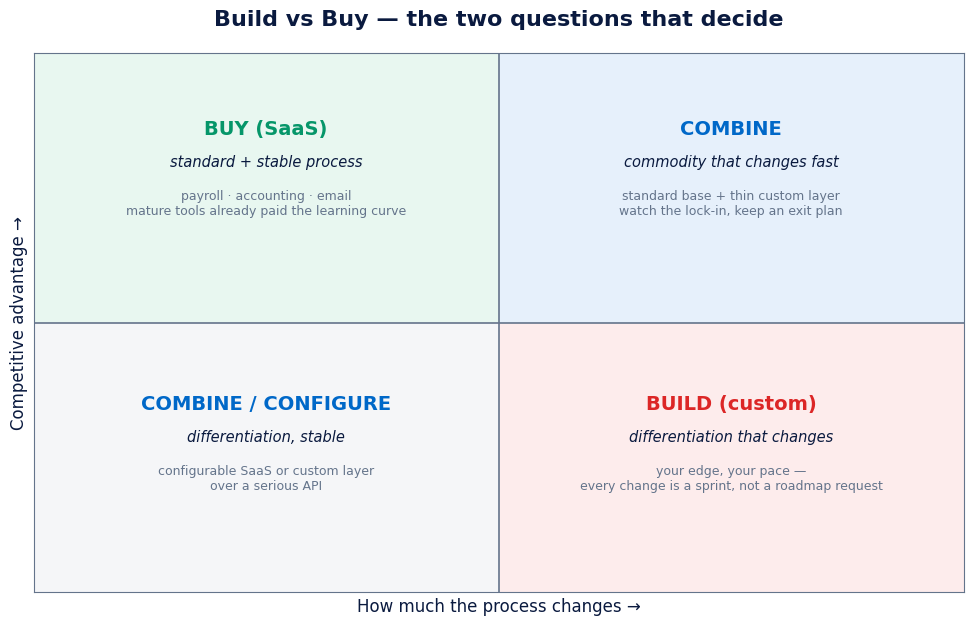
- If the process is a commodity — payroll, accounting, email, leave management — you do it the same way as your competitors and gain nothing by doing it differently. Buy. No discussion.
- If the process is your differentiation — how you quote, your logistics, your pricing algorithm, the experience you give customers — the software executing it is your business. If you use the same tool as your competitors, your advantage has an expiry date: however long it takes them to copy you.
In between lies most real-world cases: internal processes that don't sell by themselves but hold up what does. There, the second question decides.
Second Question: How Much Will It Change?
SaaS is optimised for the market's standard process. The further your process deviates from the standard — or the faster it evolves — the more friction you accumulate:
- Stable, standard process: buy. The mature tool already paid for every mistake you'd make building it.
- Stable but peculiar process: grey zone. A configurable SaaS or a thin custom layer over a standard is usually the answer.
- Process that changes every quarter (because the business demands it, not on a whim): building starts to win. Every change in a SaaS is a request to someone else's roadmap; in your own software it's a sprint.
Third Question: What Does the Friction Cost?
The hidden cost of SaaS is rarely the licence: it's the workarounds. Do this exercise with your team before deciding:
- How many weekly hours does someone spend exporting from one place and importing into another?
- How many parallel spreadsheets exist because "the tool doesn't do it"?
- How many opportunities were dropped because "the tool doesn't allow it"?
- What would it cost to migrate your data if the price jumps 40% tomorrow, or the vendor gets acquired and the product is killed?
If friction exceeds 30-40% of the licence cost, you're no longer paying €300/month: you're paying far more, spread across payroll and invisible.
The Real Five-Year Cost
The only honest comparison is total cost of ownership (TCO) over five years, with everything included:
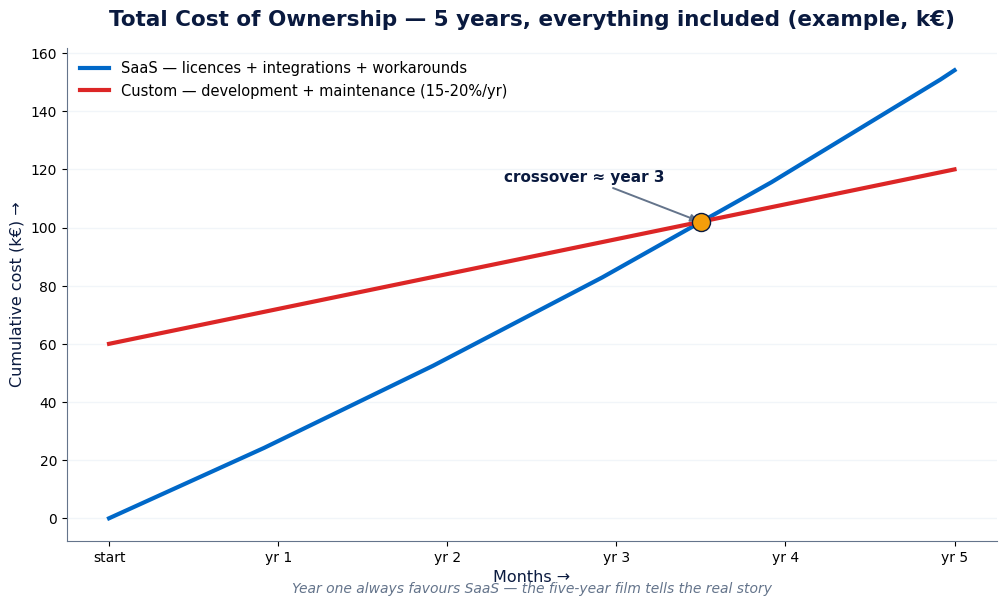
- Buying: licences (growing with users and years) + integrations + configuration consulting + training + workaround hours + the risk of price hikes or the vendor discontinuing the product.
- Building: initial development (the big line item) + maintenance (15-20% of the initial cost per year is an honest benchmark) + infrastructure + evolution. In return: the asset is yours, it adapts at your pace and you depend on nobody's roadmap.
The typical crossover — where both curves meet — usually sits between year two and year four for mid-sized processes. If your horizon is longer than the crossover, building wins in euros as well as in control.
The Option Nobody Sells You: Combine
The decision is rarely binary. The best-designed systems we see in production mix both:
- Buy the commodity, build the differentiation. A standard ERP or CRM for the generic; custom software for the process that makes you unique, integrated via APIs.
- Build thin over standards. A slim proprietary layer over open-source tools or platforms with a serious API, instead of a from-scratch custom monolith.
- Start by buying, build when the process matures. The SaaS teaches you the standard process; once you know exactly what you need differently, build with that knowledge. It's the cheapest learning path.
The rule of thumb: your custom software should only touch what differentiates you; buy or reuse everything else.
Warning Signs in Each Direction
You're over-buying if…
- You use 20% of the features of three overlapping tools.
- Your team maintains more "support" spreadsheets than processes inside the tool.
- You've said "we can't do that" because of a software limitation in the last six months.
You're over-building if…
- You've custom-built something the market already solves better (a text editor, a ticketing system, a payment gateway).
- The project is a year old and nothing is in production yet.
- Nobody in the company can explain what competitive advantage that development provides.
Common Mistakes
- Deciding on year-one price. SaaS always wins that snapshot; the five-year film tells another story.
- Building the commodity. Custom software for standard processes means paying the learning curve the market already paid for you.
- Buying the differentiation. If your competitor can subscribe to the same tool tomorrow, it's not an advantage: it's a rental.
- Ignoring the exit cost. Before signing a SaaS, ask how you export your data and what happens if the vendor shuts down or raises prices. Lock-in never shows up in the demo.
- Skipping the process test. Before building, document your current process. Half of all projects discover the problem was the process, not the tool — and fixing the process is free.
In Summary
Buy what's commodity and standard; build what's differentiation and change; combine both with serious APIs in between. Decide with five-year TCO and friction measured in hours, not with the monthly fee on the cover. And when in doubt: start by buying, learn the process, and build once you know exactly what makes you different.
If you're at this crossroads and want numbers before opinions, that's literally our job: we analyse the process, calculate the TCO of each path and honestly tell you which one we'd choose — even if the answer is "don't build anything". Tell us about your case →
Keep reading: How much does custom software cost? An honest guide to budgets.