


The problem: the most powerful LLM knows nothing about your company
Today's language models write, summarize and reason with impressive fluency. But they have two limitations that every company discovers in the first week of real use: they don't know your business (your products, your pricing, your procedures, your internal documentation) and, when they don't know something, they tend to make it up — with the same confidence they have when they're right.
For an assistant that answers customers or employees, that is unacceptable. The solution the industry has settled on is called RAG.
What RAG is, explained without jargon
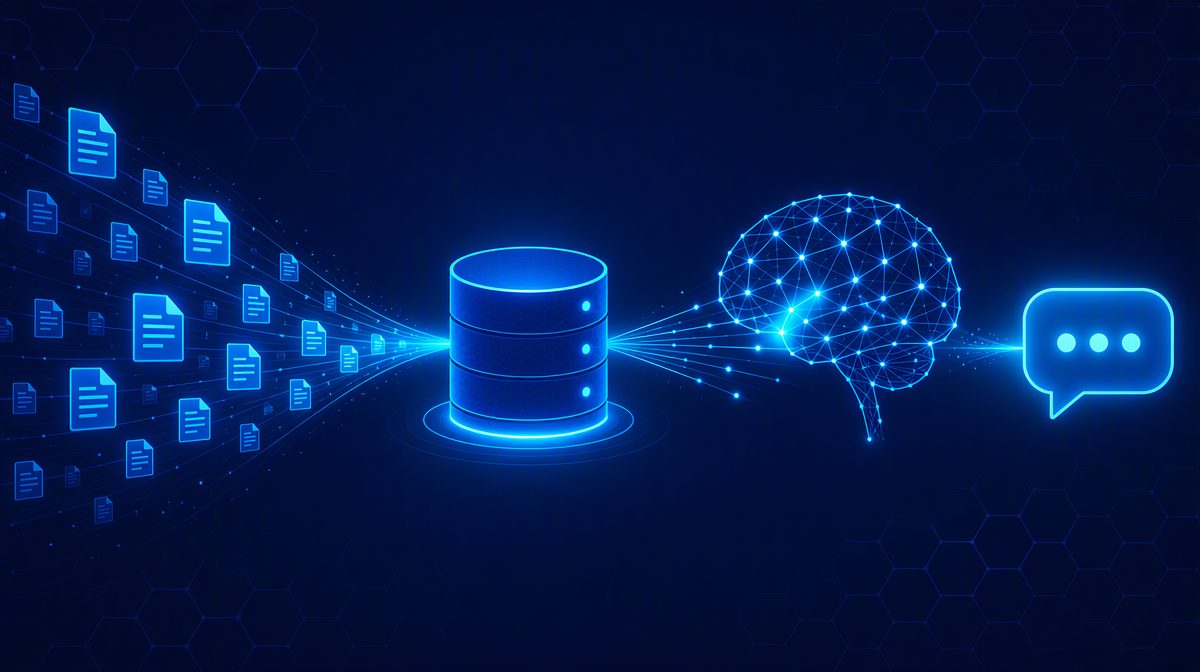
RAG (Retrieval-Augmented Generation) is an architecture that combines two steps before answering:
- Retrieve: when a question comes in, the system first searches your documentation for the most relevant fragments — manuals, FAQs, contracts, tickets, knowledge-base articles.
- Generate: those fragments are handed to the model as context, with instructions to answer based on them (and, done well, citing them).
The qualitative change is huge: the model stops answering "from memory" and starts answering with your documents in front of it. Less invention, traceable answers and always up-to-date knowledge — update a document and the next answer already reflects it, with no retraining.
How it works under the hood
A RAG system has four main pieces:
- Ingestion and chunking: your documents are split into fragments that make sense on their own. This step looks trivial and is one of the biggest determinants of final quality.
- Embeddings: each fragment is converted into a numeric vector that captures its meaning. Questions and documents are matched by meaning, not exact wording — the system finds "returns policy" even if you ask "can I send back an order?".
- Vector database: the index where those vectors live, retrieving the most relevant fragments for each question in milliseconds.
- Orchestration: the logic that decides what gets retrieved, how the prompt is built, when to abstain ("I don't have enough information") and how sources are cited.
Use cases that genuinely work today
- Customer support: instant answers grounded in your knowledge base, with human handoff when needed. It is the use case with the best return and the most mature.
- Internal documentation assistant: all the knowledge scattered across wikis, PDFs and shared drives, accessible by asking in natural language.
- Sales support: instant answers about catalog, pricing and terms, always from the current version.
- Contract and tender analysis: locating clauses, comparing versions and extracting obligations in seconds.
What separates a brilliant RAG from a frustrating one
Building a RAG demo takes an afternoon. Making it work well in production is another story. These are the factors that make the difference:
- Source content quality: if your documentation is outdated or contradictory, the system will repeat it as-is. RAG rewards healthy documentation.
- Chunking and metadata: how each document is split and labeled determines what gets retrieved. It's engineering, not magic.
- Knowing how to say "I don't know": a good system detects when the question has no answer in the sources and admits it, instead of inventing one.
- Continuous evaluation: sets of real questions with expected answers, accuracy measurement and iterative improvement. Without this, every tweak is a lottery.
- Latency and cost per answer: in production they matter as much as accuracy.
RAG or fine-tuning?
A reasonable and frequent question. Rule of thumb:
- RAG is the answer when you need the model to know things: data, documents, changing knowledge. It retrains nothing, stays current on its own, and every answer can cite its source.
- Fine-tuning is for getting the model to behave a certain way: tone, format, a very specific response style. It is not a good mechanism for "stuffing knowledge in", and it requires retraining when data changes.
In most enterprise projects the answer is RAG first, and fine-tuning only when there's a behavioral need that prompts can't solve.
Privacy and compliance: the question you must ask
Before connecting internal documentation to any model, three questions need answers: where is the data processed?, is it used to train third-party models?, who can see what? With European AI regulation underway and GDPR in full force, these answers are not optional. The good news: today it is viable to build RAG with models and vector stores deployed on European — or even your own — infrastructure, without sending a single byte outside.
How we approach it
Our approach to AI is the same as to the rest of engineering: start with the use case that has a clear return, build on maintainable architecture, and measure before scaling. A well-scoped RAG pilot — one document source, one channel, evaluation from day one — is usually a matter of weeks, and it leaves the foundation ready to grow.
If you're wondering how much of what your team searches for daily across folders and wikis could be answered instantly, you probably have a case. Tell us what documentation you have and which questions keep repeating, and we'll tell you frankly whether RAG solves it — and what it would take to put it in production.