




Every week someone asks us for "an AI agent". When we ask what it should do, the answer usually turns out to be a chatbot with one extra step — or a workflow that has existed for ten years without AI. The term "agent" has been inflated to cover anything with an LLM inside, and that inflation costs money: oversized projects, impossible expectations and autonomous solutions for problems that needed an if statement.
This guide brings order: what an AI agent actually is, where the boundary with chatbots and workflows lies, when they're worth the investment and when they're smoke with a budget.
What an AI Agent Is (A Definition That Fits on a Napkin)
An AI agent is a system where the model decides what to do next: it doesn't just generate text — it plans steps, uses tools (searching, querying an API, writing to a database, sending an email), observes the results and corrects its plan — in a loop, until the task is done.
The boundary is about who's driving:
- Chatbot / assistant: the user asks, the model answers. Zero decisions, zero actions on the world.
- Workflow with AI: a human defines the flow in advance (if A happens, do B, then ask the LLM to draft C). The AI executes steps, but doesn't decide the path.
- Agent: the human defines the goal and the available tools; the model decides the path, how many steps to take and when it's finished.
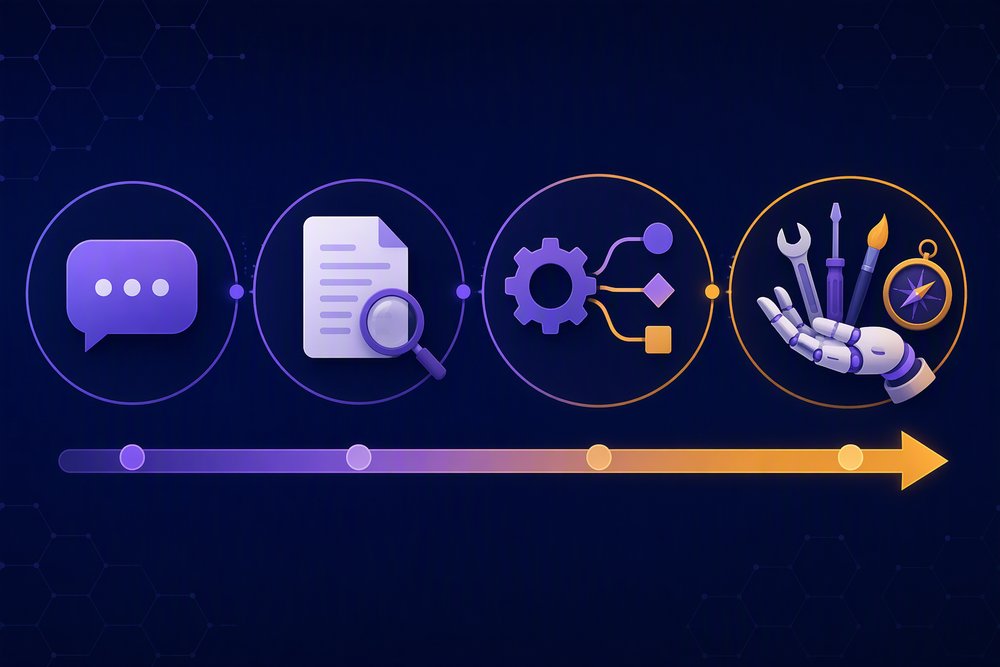
If your "agent" always follows the same path, it's a workflow. And beware: a workflow is often a better solution than an agent — cheaper, more predictable, more testable. Autonomy is a cost, not a medal.
When They're Really Worth It
An agent is justified when these three conditions hold at once:
- The path can't be written in advance. If each case requires deciding what to look at, where to search and in what order — complex technical support, research, incident analysis, reconciling data across systems — a fixed workflow falls short or becomes an unmaintainable decision tree.
- The tools exist and are reliable. An agent is only as good as the tools it can reach. If your internal API is a mess or the CRM has no API, the agent won't fix that: it will trip over it at scale.
- Errors are recoverable or supervisable. The agent that drafts support answers a human approves: great case. The agent that executes bank transfers unsupervised: a lawsuit waiting for a date.
Where we see them working in production: support agents that diagnose by consulting logs and documentation before answering, assistants that prepare reports by cross-referencing three internal systems, document processing that decides what to extract based on the document in front of it. In all of them there's a pattern: variable task, solid tools, human nearby.
When They're Smoke
- "An agent that manages my email and calendar on its own." The demo is impressive; by week three, after it has confirmed two conflicting meetings and archived an important email, less so. Full autonomy over personal tools is the reigning king of smoke right now.
- The disguised chatbot. If the task is answering questions about your documentation, what you need is RAG — as we explain in our guide — not an agent. You'll save 80% of the cost and 100% of the unexpected behaviors.
- The inflated workflow. An "invoice-processing agent" that always does: read PDF → extract fields → validate → record. That's classic automation with an LLM extraction step. Perfectly fine as a solution; just don't pay agent prices for it.
- Multi-agent by default. Teams of agents coordinating with each other is, today, interesting research and expensive, fragile production. One well-built agent beats five badly coordinated ones.
What Nobody Tells You About the Costs
An agent is not an LLM endpoint with more passion. The real budget includes:
- Multiplied tokens: every loop step is a model call with all the accumulated context. A ten-step task can cost twenty times a single call — and mid-way failures are paid for too.
- Tool engineering: every tool the agent can use needs a clear interface, input validation, limits and error handling designed for a "user" that doesn't understand implicit conventions. It's real API development.
- Continuous evaluation: an agent isn't tested like normal code. You need evaluation suites with real cases, because the model gets updated and behaviors drift. Without evaluation, you learn about regressions from your users.
- Guardrails: step limits, cost-per-task limits, actions requiring human approval, and complete logs of every decision. When the agent does something weird — it will — you need to reconstruct why.
How to Start Without Burning the Budget
- Start with the workflow. Automate the process with fixed steps and an LLM where it adds value. If 90% of cases follow the same path, it stays there — and you've won cheaply.
- Identify the real branching point. Only if there genuinely are cases requiring unpredictable routes, introduce bounded autonomy: the agent decides within one stretch, not the whole process.
- Measure before scaling. Success rate per task, cost per task, human interventions required. If those three numbers don't beat the workflow, the agent isn't justified — however pretty the demo.
- Human in the loop from day one. Approve sensitive actions, review samples of decisions, and remove supervision only when the evidence justifies it.
In Summary
An AI agent is a system that decides its own path toward a goal using tools — and that autonomy is exactly what makes it powerful and expensive. It's worth it when the path is unpredictable, the tools are reliable and errors are recoverable. It's smoke when the task has a fixed path, when RAG solves the same thing, or when the demo promises full autonomy over things that hurt when they fail. Start with the workflow, introduce bounded autonomy where it's proven necessary, and measure before scaling.
If you're considering agents for your product or internal processes, we'll tell you frankly where the boundary between workflow, RAG and agent lies in your specific case — and we build it with the guardrails production demands. Let's talk about your case →
Keep reading: RAG in production: when it's worth it and when it's overengineering.